
Peter Schiff’s ‘$75K Bitcoin call’ meets a vital week: Fed, inflation, and ETF outflows loom


Is Bitcoin’s recent pullback just the start of a bigger crash?
The last 24 hours have been a reality check for investors. However, looking at how the upcoming week could unfold, this pullback might turn out to be more bullish than bearish.
The logic is simple: With BTC falling beneath $80k, traders may be more hesitant to lever up chasing long positions, potentially reducing the risk of excessive bullish positioning.
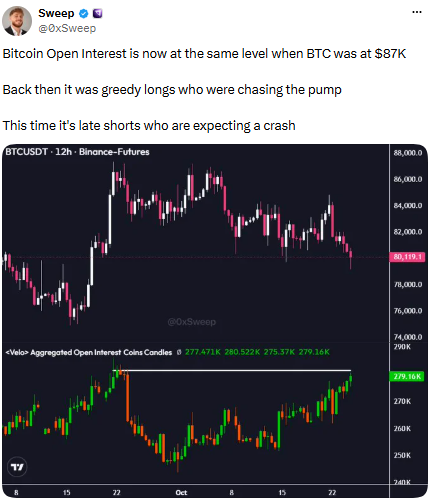
Interestingly, the on-chain data indicates that Bitcoin’s Open Interest (OI) has returned to the same levels as during the $87k rally. However, this time more late shorts are entering the market, compared to the previous situation whereby greedy longs were buying the rally.
So, if the bears become overcrowded, this can actually lead to a short squeeze instead.
Adding to this, the past 24 hours saw a textbook liquidity sweep.
According to CoinGlass data, more than $400 million in longs were liquidated, marking the largest single-day long liquidation event in nearly two weeks.
But here’s the catch: During the previous event, BTC barely moved even after more than $500 million of longs were wiped out, causing the price to consolidate around $85k.
This time, however, bulls seem to be struggling to absorb the pressure, raising questions about if there’s enough strength in Bitcoin to rally back.
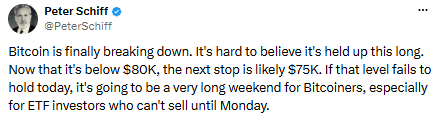
Notably, this is where Peter Schiff comes in with his latest Bitcoin [BTC] forecast.
The skeptic believes that $75k is the next bearish target for Bitcoin. He warns that increased macro uncertainty could lead to large ETF redemptions once U.S. markets reopen on Monday. Since ETF investors cannot trade over the weekend, any sell-off will have to wait until markets open.
The big question now is whether fading momentum will push Bitcoin to $75k or if the recent liquidity sweep has already cleared enough leverage for a relief bounce.
Bitcoin faces a critical test as bearish bets build below $80k
Looking ahead, the growing bearish positioning around Bitcoin might be more than just a fluke.
Next week looks to be a busy one for macroeconomic catalysts. The Fed, Big Tech, US inflation figures, and the Bank of Japan all come into play. With concerns about an AI bubble already impacting market sentiment, disappointing earnings from Google and Amazon could have a negative impact.
Adding the Fed into the mix, it’s easy to see why traders are taking a more cautious approach and leaning bearish on Bitcoin.
Furthermore, the market is not looking so bullish on the forthcoming U.S. mid-term elections. Some analysts are referring to this as a “midterm curse” for Bitcoin, as historically the price has plummeted by 72% in 2010, 65% in 2014, 52% in 2018, and 27% in 2022.
Combine this with increasing macro uncertainty, liquidation risks, and waning momentum, and the bear story starts to make more sense.
So, while it isn’t certain, there are actually several factors to suggest that the downside risks for Peter Schiff’s BTC price forecast are real.
Thus, this is a delicate week for Bitcoin, with the Fed, inflation, big tech earnings, and possible ETF outflows. If the bearish momentum takes hold, the market could see a much larger crash.
Final Summary
Bitcoin’s drop below $80k could push BTC toward Peter Schiff’s $75k target.
Fed updates, inflation data, and ETF outflows could trigger a bigger Bitcoin crash.

Comments are closed.